
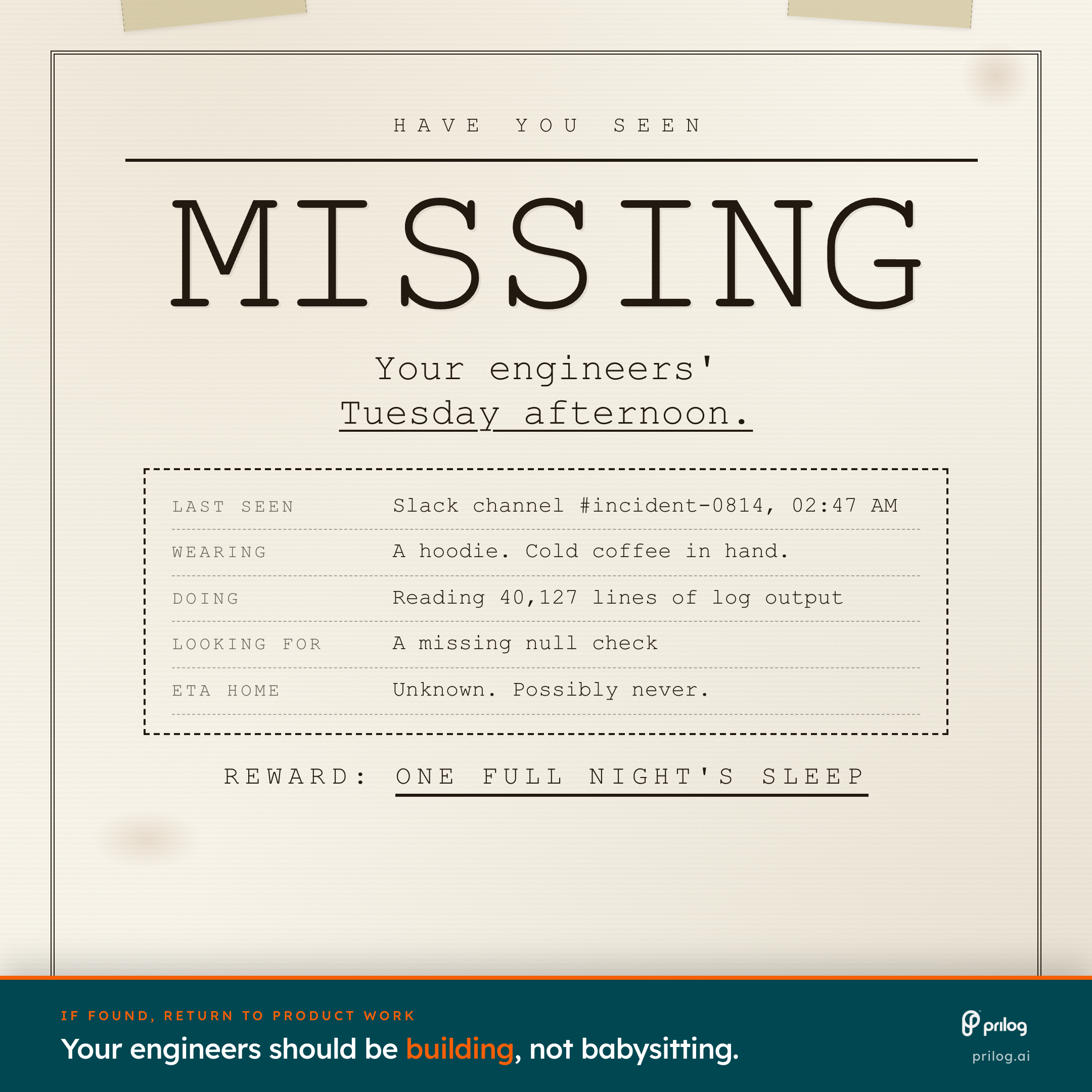
Your engineers are not the problem. The work you are giving them is.
Look at the last sprint honestly. How much of it was building something new, and how much of it was supervising what is already deployed?
On-call shifts. Triage rotations. Investigations that end with a missing null check. Post-mortems for the same regression three times in one year. A platform team that is technically a platform team, but in practice exists to keep the lights on. A Slack channel called #firefighting that nobody wants to mute because muting it feels irresponsible.
We have convinced ourselves this is engineering.
It is not. It is supervision.
The expensive work is not always the impressive work
Production maintenance can look serious from the outside. Dashboards are open. Threads are moving. Logs are scrolling. Engineers are making judgment calls under pressure.
Some of that work is necessary. A lot of it is just the organization asking humans to be the backup system for incomplete automation.
The best engineers on your team did not join to refresh incident channels, compare the same deploy window twice, or babysit a pipeline until something turns red. They joined to build product, improve architecture, remove constraints, and create leverage.
When a third of their week goes into production supervision, the company does not just lose hours. It loses the compound effect of senior engineers thinking about the future.
The pattern repeats because the loop is manual
Most recurring production work follows a familiar path:
- Something fails.
- An alert reaches a human.
- The human opens traces, logs, deploy history, and recent commits.
- Someone asks who owns the service.
- The team debates whether it is a bug, a bad deploy, an upstream issue, or a data edge case.
- The actual fix turns out to be small.
The fix is not always hard. Getting to the fix is what burns the afternoon.
That gap is where teams lose product momentum. It is also where AI agents can help without taking control away from engineers.
In 2026, this is a fixable problem
Self-healing software does not mean a model silently changes production. That is not what serious engineering teams want.
The better model is narrower and more useful:
- read the trace
- summarize the failure
- compare the deploy
- find the likely regression
- identify the owner
- draft the pull request
- show the evidence
- wait for approval
That gives engineers back time without removing engineering judgment. The human still reviews the diagnosis, edits the patch, checks the tests, and decides whether to merge.
The agent handles the supervision work. The engineer handles the decision.
The CTO question is changing
The question for every CTO this quarter is not only, "Do we have enough engineers?"
It is also, "Why are our engineers doing work an agent can prepare in 90 seconds while waiting for human approval to ship the fix?"
If the answer is compliance, ownership, or safety, that is valid. Those constraints matter. But they do not require every step before review to stay manual.
Teams can keep control and still automate the repetitive path from production signal to reviewed pull request.
Give engineers back product time
Your strongest engineers should not be missing from product work because they are reading 40,127 lines of log output.
They should not be the redundancy layer for CI/CD.
They should not spend Tuesday afternoon proving, again, that the same class of regression came back.
They should be building the thing the company actually raised money to build.
The goal is not to eliminate operational responsibility. The goal is to stop treating human attention as the cheapest monitoring primitive in the system.
Your engineers should be building, not babysitting. Give them back the time to build.