
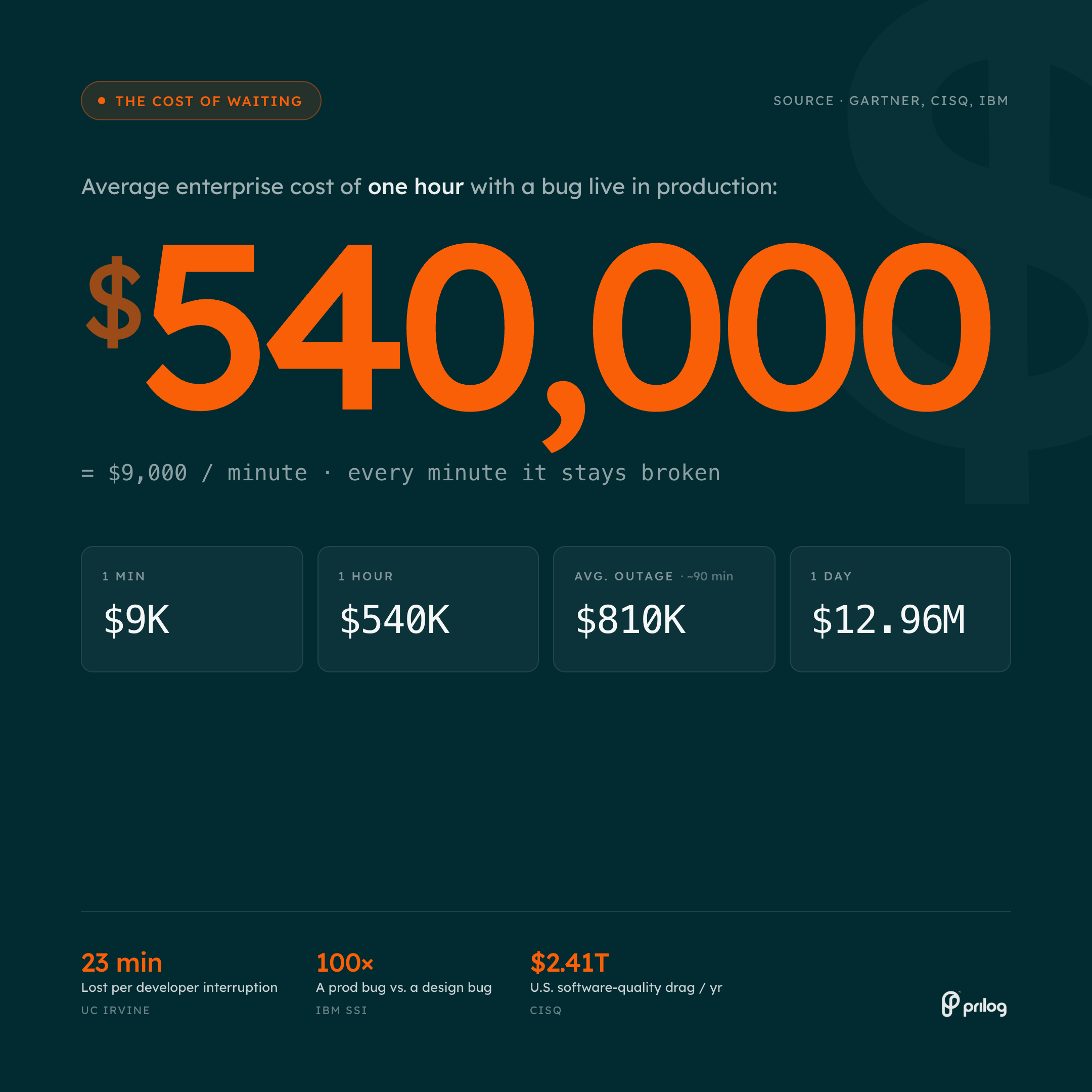
Teams often talk about production bugs as if the cost is contained inside the defect. A bad conditional shipped. A migration missed an edge case. A queue consumer retried too aggressively. Fix the code and the cost ends.
That view is too small.
The cost of a production bug is not only the line of code that caused it. It is the time the organization spends living around it.
Waiting changes the shape of the incident
A bug that is fixed in five minutes is usually a code problem. A bug that waits for an hour becomes a coordination problem. A bug that waits for a day becomes a trust problem.
The same underlying defect can create very different damage depending on how long it stays live:
- Customers hit the same broken path repeatedly.
- Support teams collect tickets without a confident answer.
- Sales or success teams start writing temporary explanations.
- Engineers pause nearby deploys because they are not sure what is safe.
- More data enters the system in a bad or partially handled state.
- The original deploy context fades from the people who had it.
None of these costs are exotic. They are normal production drag.
MTTR misses some expensive minutes
Mean time to recovery is useful, but it can hide the moments that create the most waste.
The clock usually starts when a problem is detected and stops when the service is considered recovered. That says something important about reliability. It does not tell you how much of the incident was spent understanding the failure, finding the owner, assembling evidence, or waiting for a reviewable change.
For remediation workflows, the expensive gap often looks like this:
alert -> evidence -> code path -> owner -> patch -> review -> deployIf the team can compress the first four steps, the code review starts earlier and the final fix becomes easier to evaluate.
Context decay is real cost
Recent code is easier to reason about. The author remembers why the change happened. Reviewers remember the discussion. The feature flag, rollout plan, and test assumptions are still fresh.
As time passes, the investigation gets heavier. Engineers reread decisions they made hours ago. They reconstruct the deploy window. They re-open dashboards. They ask whether the issue is related to another incident. The fix might still be small, but the confidence needed to merge it gets harder to build.
Fast remediation is not only about speed. It is about preserving context while the team still has it.
The cost is not always visible in engineering dashboards
Some production issues look modest in telemetry and still hurt the business.
A permissions bug might affect a small number of high-value accounts. A billing-state bug might appear as a low-volume edge case while creating manual finance work. A checkout issue might only affect one payment method in one region, but the support impact can be immediate.
Engineering dashboards are necessary, but they rarely capture the whole recovery burden. The right incident brief should include customer path, account or tenant impact when available, support signal, and code ownership alongside traces and logs.
What reduces the waiting cost
Teams reduce waiting cost when they make investigation and review happen in the same loop.
That means:
- the alert is tied to the relevant traces and logs
- the failure window is compared with deploys
- the suspected code path is named
- ownership is resolved automatically
- the proposed patch is small enough to review
- uncertainty is visible instead of hidden behind confident wording
This is where AI-assisted remediation is useful. It should not make a secret production change. It should prepare the evidence, draft the smallest plausible fix, and hand the owner a pull request that can be accepted, edited, or rejected.
The real metric is time to a good decision
A team does not win because a bot produces a diff quickly. It wins when the right reviewer can make a good decision sooner.
Sometimes that decision is "merge the fix." Sometimes it is "roll back." Sometimes it is "this is an upstream incident." Sometimes it is "we need a human investigation, not a patch."
Waiting is expensive because it delays all of those decisions. The goal is not frantic automation. The goal is a shorter path from production signal to evidence-backed action.